By Cory Sekine-Pettite
In Cobb County, The Walker School gives students something increasingly hard to find: the opportunity to be challenged deeply without having to choose just one way to excel.
A student can love calculus and theatre. Robotics and French horn. Soccer and history. At The Walker School in Marietta, those combinations are not unusual. They are part of the point.
For families looking for an academically ambitious school, Walker offers the expected markers of rigor: 26 AP courses, seven post-AP and Advanced Topics courses, 18 science and robotics labs, and a faculty in which 70 percent hold advanced degrees. Every graduate is accepted to college, and Niche’s 2026 rankings named Walker the No. 1 high school for STEM in Cobb County. Let’s explore what is behind those numbers.
What happens when a school knows a student well enough to know when to push?
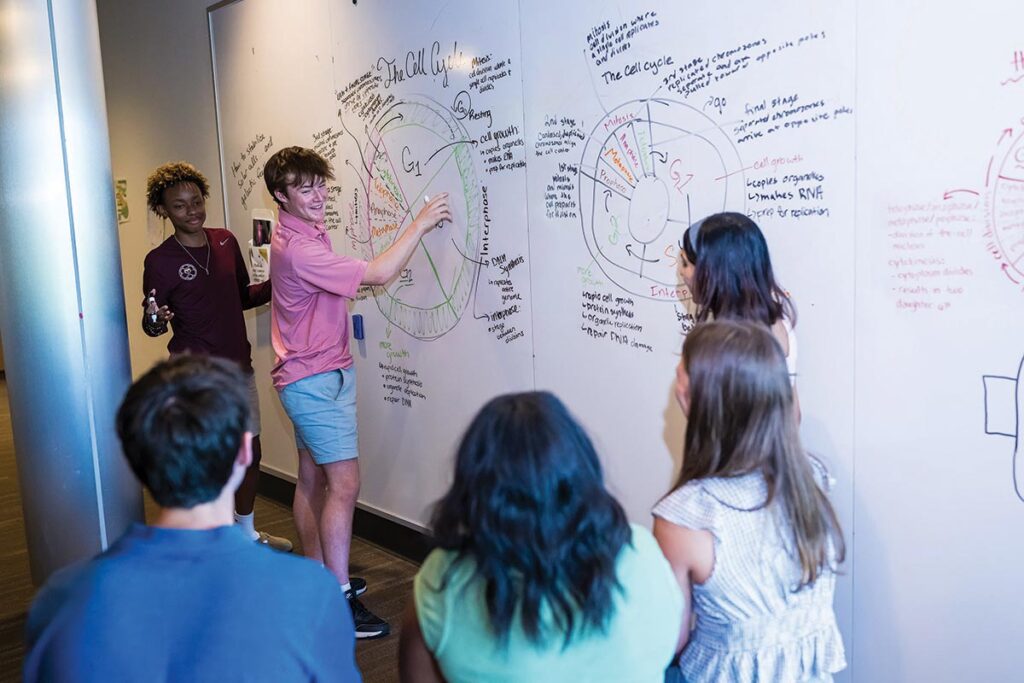
With an average class size of 15, Walker teachers have the opportunity to understand how individual students think, where they are struggling, and where they are ready to go further. Rigor is not simply a higher-level course on a transcript. It is a teacher asking a better question, challenging a first answer, or encouraging a student to pursue an idea a little further. That philosophy begins early.
Young students build strong foundations in literacy, mathematics, and communication while also exploring science, technology, engineering, art, music, and Spanish. In Lower School, students move from hands-on mathematical experiences toward increasingly abstract thinking while working in both whole- and small-group settings.
The goal is not simply to move students faster. It is to help them understand why. By Middle School, students have more opportunities to shape their experience. They can explore Latin, Spanish, and French; pursue engineering, robotics, computer science, or digital media; and take on projects that ask them to apply what they know. Sixth-graders partner with the University of Alabama in Huntsville to launch and analyze a weather balloon. Eighth-graders design and race Newton cars before analyzing their results and writing a formal report. Students who are ready for more can take advanced seminars in English, science, and U.S. history.
By Upper School, that freedom becomes even more significant. Students can move beyond AP into courses such as Linear Algebra, Multivariable Calculus, and Advanced Topics in Mathematics. They can pursue concentrations in Engineering, Public Health or the Humanities, conduct research, complete capstone projects, and build schedules that reflect their individual interests.
The humanities receive the same level of attention. Students develop as critical readers, persuasive writers, and thoughtful participants in discussion, with opportunities to explore everything from Civil Rights to Abnormal Psychology and U.S. Military Interventions.
The message is consistent across disciplines: Go deeper. Ask better questions. Make something of what you discover.
More Than a STEM School
Walk through Walker and the academic ambition is easy to see in the labs, robotics teams, and technology courses. But STEM is only part of the story.
Students can pursue serious work in literature, history, languages, visual arts, music, theatre, and the humanities. The school encourages them to connect disciplines rather than treat them as separate worlds. That matters, because life after school rarely fits neatly into one subject.
An engineer has to communicate. A physician has to understand people. A business leader has to evaluate evidence, listen to competing perspectives, and make decisions when there is no obvious answer. Walker is preparing students for that kind of complexity.
At Walker, learning is not only about what students know. It is also about how they approach difficult questions, respond to setbacks, communicate with others, and take responsibility for their own growth.
One Walker graduate from the Class of 2015, who went on to Harvard and later graduate work at Columbia, recalled entering college feeling exceptionally prepared; some introductory engineering material at Harvard was content he had already encountered at Walker. That is a useful distinction.
The goal is not simply to get students into impressive colleges.
It is to help them arrive ready to contribute.
The Class of 2026 offers another measure: Walker’s 122 seniors were accepted to 268 individual colleges and earned more $11 million in scholarship dollars, with acceptances including Case Western, Columbia University, Cornell University, University of Chicago, Emory University, University of Georgia, Georgia Tech University, Howard University, University of Michigan, Northwestern University, Spelman College, Tulane University, University of Virginia, and Vanderbilt University.
The outcomes are impressive. But the habits behind them are more important.
Students Don’t Have to Choose One Lane
Perhaps the most distinctive part of the Walker experience is that academic ambition does not require students to narrow themselves. A demanding schedule does not have to mean giving up athletics, music or the arts. Walker’s rotating schedule helps minimize the impact of athletic competitions and other activities on classroom learning, giving students room to pursue multiple interests.
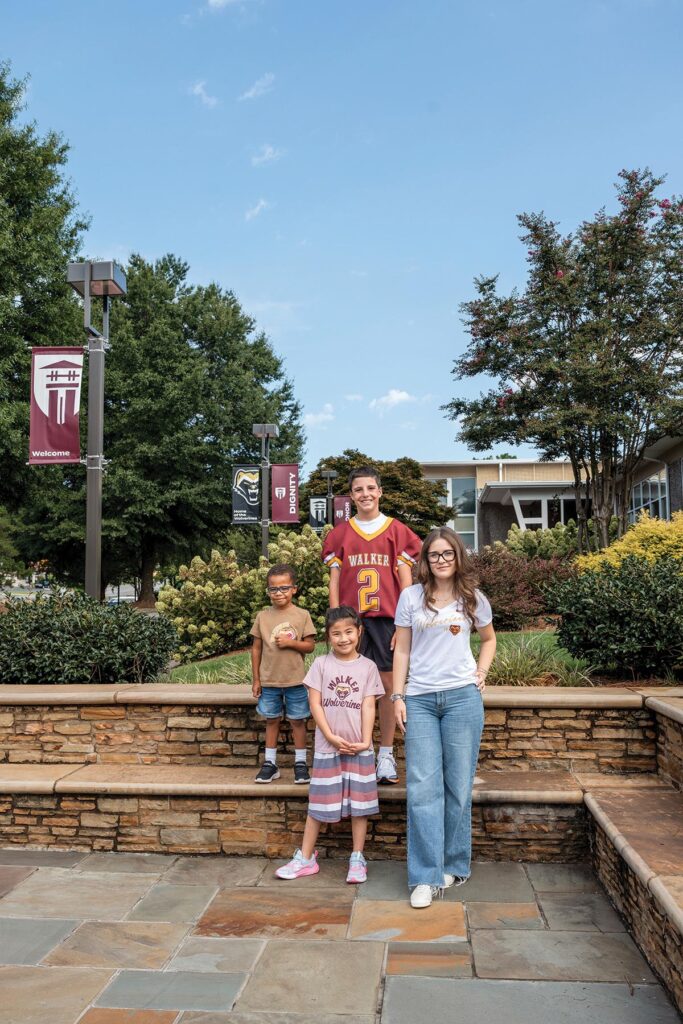
That might mean advanced science and theatre. Robotics and visual art. Football and French horn. Or something a student — and their parents — never expected when they first arrived. With 72 percent of students in grades 6–12 participating in athletics and extensive opportunities across the visual, performing and technical arts, students have room to discover what they are good at rather than having to arrive with the answer.
For parents, that can be a meaningful distinction. You are not simply choosing a school that will help your child become better at what they already do. You are choosing a school where they can discover what else they might become.
A Strong Fit for Cobb County Families
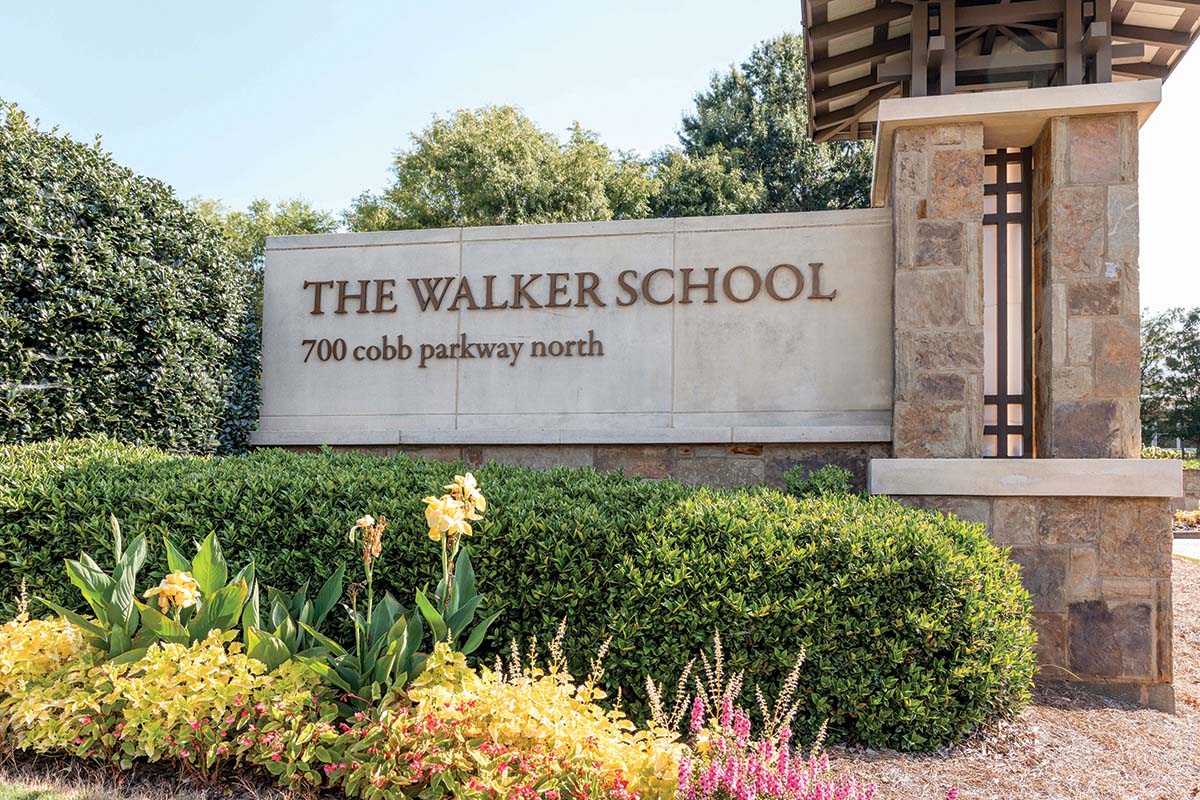
Walker has served the Marietta community since 1957 and today brings together approximately 1,000 students from PK3 through grade 12.
For families in Cobb County, that combination of continuity, breadth, and proximity matters. Siblings can grow up within one school community. Two-way bus service provides access from multiple areas around metro Atlanta. Extended-day care is available for younger students until 6 p.m.
And as the only non-sectarian independent school in Cobb County, Walker offers a distinctive educational environment for families who want the benefits of an independent school without requiring a particular religious identity. Most importantly, students encounter a community where relationships matter. Teachers know them. Coaches know them. Advisors know them. And because they are known, students can be challenged as individuals, not simply as members of an age group or as numbers on a transcript.
The Walker Difference
For families considering independent schools in Cobb County, the question is not whether Walker offers academic rigor. It clearly does.
The more interesting question is what kind of student that rigor is designed to produce. Not simply a student with an impressive transcript. A student who can think independently. Write clearly. Ask good questions. Listen to people who see things differently. Recover from a failed experiment. Pursue an idea beyond the assignment. And recognize that there is always another level of understanding to reach.
That is the balance Walker offers: Rigor without rigidity. Individual attention without lowered expectations. Breadth without sacrificing depth. A student can find something they love, pursue it seriously, and still have room to discover something new.
For families across Cobb County, that may be the most compelling reason to take a closer look at Walker. Because the goal is not to force students into one lane.
It is to give them the knowledge, confidence and curiosity to decide where they want to go next.